
As digital storage demands grow, understanding SSD and HDD becomes increasingly important. Solid State Drives (SSDs) offer faster performance, lower power consumption, and greater durability, while Hard Disk Drives (HDDs) provide higher storage capacity at a lower cost.
Many wonder whether SSDs are more reliable than HDDs and whether SSDs will completely replace HDDs. While SSDs dominate consumer devices, the difference between hard disk drives and solid state drives ensures HDDs remain indispensable for bulk storage and long-term archiving in the near future.
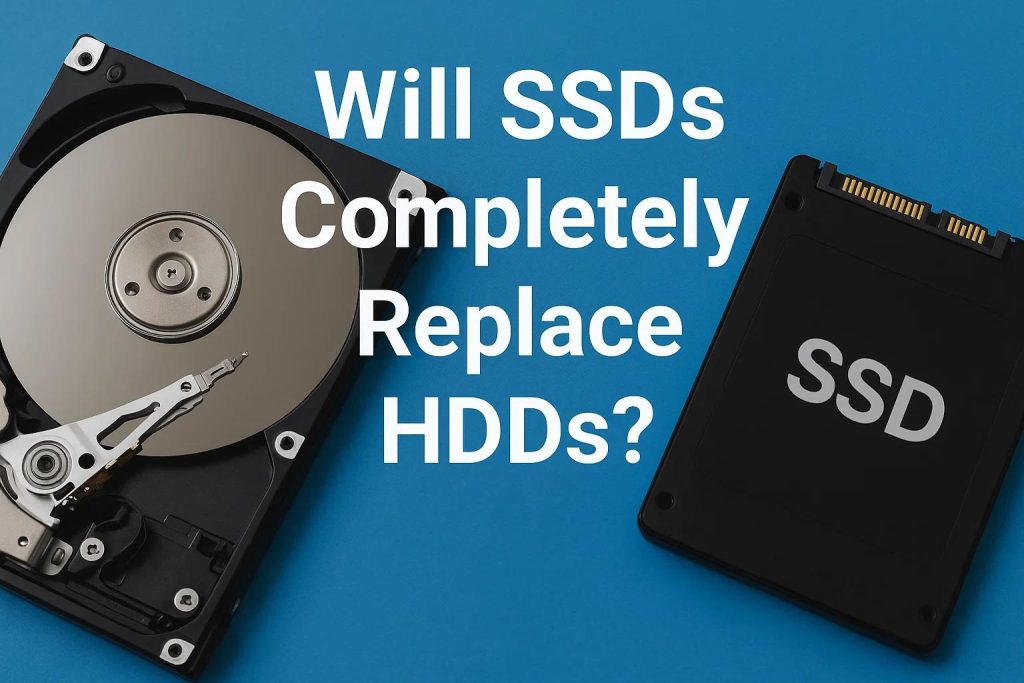
What is SSD vs. HDD?
A Solid State Drive (SSD) is an electronic storage device that uses flash memory chips (NAND Flash) to store data, with no moving mechanical parts.
A Hard Disk Drive (HDD) is a mechanical storage device that reads and writes data using a moving head on rapidly spinning magnetic platters.
| Aspect | Solid State Drive (SSD) | Hard Disk Drive (HDD) |
| Core Technology | Integrated circuits (NAND Flash chips) | Mechanical moving parts (actuator arm & spinning platters) |
| Performance | Extremely Fast: Millisecond latency, excellent random read/write and IOPS | Relatively Slow: High latency in random reads/writes due to physical seek time |
| Physical Traits | Silent, shock-resistant, lightweight, low heat generation | Audible noise and vibration, sensitive to physical shock, larger and heavier |
| Capacity & Cost | Higher cost per GB | Very low cost per GB |
| Durability | Limited write cycles (sufficient for typical consumer use) | Theoretically unlimited writes (mechanical failure is the primary risk) |
| Power Consumption | Lower power draw during both active and idle states | Higher and more consistent power requirement, especially during spin-up and operation |
Typical Use Cases
l Choose an SSD for performance and responsiveness:
- Primary drive for OS and applications
- Laptops, ultrabooks, and mobile devices
- Fast game loading and level streaming
- Scratch disk for professional creative work (e.g., video editing)
- High-performance databases and virtual machines
l Choose an HDD for capacity and cost-efficiency:
- Mass storage for backups and cold data archiving
- Home NAS and media libraries
- High-capacity data center storage arrays
- Surveillance video recording and large log files
Emerging Technologies and Future Trends
1. Advances in SSD Technology
SSD technology is progressing along two main fronts: increasing density and reducing cost. QLC NAND serves as the key driver, with SK Hynix’s mass production of 321-layer QLC further lowering $/TB.
On the interface side, the NVMe protocol continues to evolve—the 2025 specification has updated Zoned Namespace to version 1.4, effectively reducing write amplification and improving read-write stability.
In terms of capacity, the combination of QLC and advanced packaging is pushing enterprise SSDs beyond 200TB, with several vendors revealing solutions of 256TB. The advantage of SSDs now lies not only in interface speed but also in high density, high parallelism, and intelligent data management.
2. Potential HDD Innovations
Hard drive technology also continues to progress. HAMR (Heat-Assisted Magnetic Recording) has entered commercial deployment, with Seagate shipping 30 TB drives and outlining a clear roadmap toward 40+ TB. Western Digital, using OptiNAND-enhanced ePMR, has released 32TB UltraSMR drives.
The core HDD strategy remains maximizing per-drive capacity to maintain a significant cost advantage, securing its role as the essential storage tier for massive cold data archives.
3. Market Trends and Projections
The AI wave is redefining storage needs. On one hand, AI training requires high-speed data throughput, making SSDs the preferred medium for AI workloads. On the other hand, AI also generates vast amounts of data for preprocessing and long-term retention, where HDDs remain the most economical solution for warm and cold storage.
Notably, the HDD market faced significant supply shortages in 2025, with lead times extending considerably. This reflects a highly concentrated supply chain adapting to structural shifts in demand.
Regarding reliability, data from Backblaze confirms that SSDs now demonstrate lower annualized failure rates than HDDs in their environments. That said, both media types are highly reliable, and any robust storage strategy must be built on a comprehensive backup architecture.
Cooperate with UniBetter for Your Memory Needs
In the evolving landscape of data storage and computing, UniBetter is your trustworthy partner. We stand out as a leading electronic component distributor with proven reliability and global reach.
Ranked 21st in the 2025 Top 50 Global Electronics Distributors and among the Top 3 in the Asia Pacific region, UniBetter connects customers to over 7,000 verified suppliers worldwide.
We ensure genuine, traceable components, fast BOM quotations, and design support to optimize sourcing efficiency. Serving industries from computing and storage to automotive, IoT, and energy, UniBetter delivers stable, long-term supply solutions that help businesses stay ahead in a fast-changing market.
Conclusion
While SSDs continue to expand their dominance in performance-driven applications, HDDs remain vital for large-scale, cost-efficient data storage. The future of storage will likely feature both technologies coexisting to meet diverse demands from AI to cloud infrastructure.
As the market evolves, choosing a reliable sourcing partner becomes crucial. Contact UniBetter today to access authentic, high-quality electronic components and comprehensive support for your storage and computing solutions.
References:
- https://www.tomshardware.com/pc-components/ssds/sk-hynix-announces-mass-production-of-its-2tb-3d-qlc-nand-cheaper-high-capacity-consumer-drives-and-244tb-enterprise-ssds-incoming
- https://nvmexpress.org/specification/nvme-zoned-namespaces-zns-command-set-specification/
- https://www.tomshardware.com/pc-components/hdds/seagate-unveils-30tb-hdds-for-the-masses-laser-powered-hamr-drives-are-now-widely-available
- https://www.tomshardware.com/pc-components/hdds/western-digital-launches-32tb-hard-drive-in-sata-and-sas-flavors-ultrastar-dc-hc690-delivers-sequential-performance-up-to-257-mib-s
- https://www.backblaze.com/blog/how-reliable-are-ssds/